- W.R. Schock, QBD
- Articles
- Blog2
- Editor
- Blog Summary
- Blog Summary 3
- Blog Summary 1
- Blog Summary 2
- Keys To Heaven
- LOOSH AND THE DISNEY WORLD
- IRS, INCOME TAX
- TIME TRAVELER
- HUMANS VERSUS INVADERS
- PROJECT LOOKING GLASS
- PLANNING YOUR MANIFESTATION CYCLES
- TOXOPLASMA GONDI PARASITE AND CLEANERS
- HUMAN ANIMAL SPECIES
- HANSEL AND GRETEL
- MAFIA, WORLD UNDER BLACKMAIL
- MICHAEL JACKSON
- NAVAL SPACE COMMAND, THE REAL NASA
- KNIGHTS TEMPLARS
- THE GALACTIC FEDERATION & ASHTAR COMMAND
- PORPHYRIA -BLUE BLOOD DISEASE
- RESET 1893
- SKY ICE
- BRUCE LEE, GENE HO
- ANNOUNCEMENT ANTIGRAVITICS
- SONOPHORESIS TELEPORTATION & PEMF
- OPENING OF THE BOTTOMELESS PIT
- TWO CHRISTS
- TRUMP, THE ANTIKRYST? Pt 1
- TRUMP, THE ANTIKRYST? Pt 2
- THE LUCIFERIAN TREATY
- CHOOSING FROM DUAL SPIRIT PATHS
- THE SUN DOES NOT EMIT LIGHT OR HEAT
- MIRRORS ARE SPACETIME FABRIC SCREENS
- CLARITY
- DREAMS
- STARGATES & TEMPLAR CUE SITES
- CURSIVE WRITING IS CASTING SPELLS
- ERASING PAST KARMA
- PARTICLE AND ANTIPARTICLE WORLDS
- WHAT ABOUT BEING TRICKED?
- HUMAN ALIEN IMPLANTS
- ZERO POINT ENERGY: WHERE DOES IT COME FROM?
- CASTING THE APOCALYPSE
- QUANTUM ENTANGLEMENT AND PEMF
- THE DOME
- PAN CLARA AWAKENING WAVES
- WHO WILL MAKE TRANSITION
- SCIENCE OF PREDICTIVE PROGRAMMING
- BUDHARA BORJA RETROVIRUS (AI)
- SURGICAL SEPARATION OF THE 2 PLANES
- MANDELA EFFECT
- THE HISTORY OF THE CHIMERA PT1
- THE HISTORY OF THE CHIMERA-2
- SCIENCE OF ELEVATING CONSCIOUSNESS
- MAGIC MONEY PROGRAM
- GERMANY WON WW2
- SOPHIA
- THE ARTIFICIAL SUN
- PARALLEL INTERDIMENSIONS
- 7.83Hz HUMAN HYPNOSIS
- GIFTED & TALENTED STARSEED H@RVESTING PROGRAMS Pt 1
- GIFTED & TALENTED STARSEED H@RVESTING PROGRAMS Pt 2
- INDIGO MISSIONS
- THE EMERALD COVENANT
- HOW THE HOLOGRAPHIC SIMULATION WORKS
- THE SEPARATION
- MANIFESTING YOUR GOALS
- PRIME CREATOR
- DESTINATIONS AFTER THE SEPARATION
- CASTING A BETTER REALITY
- RESCUE OF THE KEEPER OF TARA EARTH
- AUTHENTICITY
- KNOWLEDGE IS FREQUENCY
- PHOTONIC CODE
- THE ORDER OF MELCHIZEDEK
- HARD RED PILL
- HARD RED PILL 2
- Privacy Policy
PORPHYRIA -BLUE BLOOD DISEASE
The reference to blue blood being different from red blooded humans is clinical fact that royal blood (a bluish purple) is reptilian that doesn't coagulate should they get cut, unless they consume red (human) blood on a regular basis. And even then, they can still suffer from 'porphyria' in many different ways, including going mad. This is because that blood type was 'smuggled' into this realm against official treaty. It is an atmospheric complication.
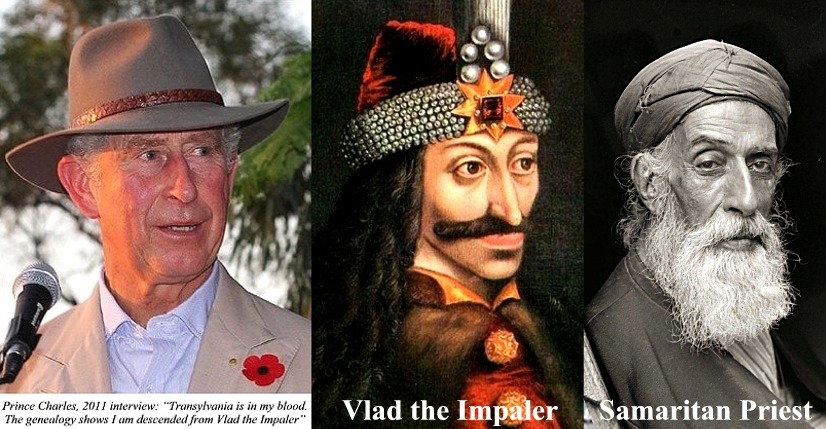
When King Charles visited Transylvania he admitted to the press that he was a direct bloodline descendant of Vlad Dracul (that drank his victim's blood daily with lunch, and suffered from acute porphyria). Vlad was known as Vlad Dracula, Vlad the Impaler and Vlad the "Dragon". The "Dragon" reference is to Enki Lucifer, the patrilineage father from the lines of the Leviathan Seraphim Zephelium Anunnaki. The Leviathan portion of that bloodline are actual dragons. This is an O negative bloodline, meaning there is no Rhesus monkey genes in their bodies. All children of Adam & Eve have Rhesus monkey genetic markers, as that new Hyksos human hybrid creation had some human-earth monkey DNA added to make them more agile. It is physically impossible for Rhesus monkey genes to be in a human body outside of genetic splicing as the two species cannot procreate together.
If you have a plus sign + after your blood type, you came from Adam & Eve (Neanderthal, Cro-Magnon, J3wish and Adam Kadmon). If you don't, then you are either one of the original humans that predated the Eden event by almost 550m years, or you are from one of the many dozens of ETs that were given 'pass-through' integration into human-earth's realm via the hybrid human vessel of Eve that happened concurrent with the creation story in the Garden drama.
The bloodline of Cain was a pass-through creation that skipped Adam entirely as Enki bred with Eve in the Garden (first born, before Able and before dozens of other pass-throughs never mentioned to you in the Eden story). There were five Eves, not just one. The same person's awareness was in all five physical bodies that were created to pass through the many new hosted hybrid species. They were all fractals of Ninhursag, but we'll refer to her separately from the 'Eve 5' to make the story easier to follow.
Ninhursag created a formula that allowed Eve's womb to give birth to Cain -and many other species as mentioned- without imbuing the child with her Rhesus monkey genetics. This process passed on Enki's genetics, preserving special 'god-like' abilities of his Leviathan ancestry to Cain, such as being able to holographically change his appearance, telepathy, telekinesis, clairvoyance and more. These are clair abilities normally associated with Elohim beings that his bloodline picked up when the Anuhazi Elohim bioformed his race to use them as warriors against the human race.
The other 50+ ET species that were given 'pass-through' birthing through the Eve 5 surrogates that preserved unique pre-existing abilities of each species that varied wildly from each other in some cases. Not every ET can vanish, fly or hover, etc. as an example.
The problems blue-bloods have had all down through time have been constant but hidden from the great unwashed, but it is the real reason for the story of the Emperor's New Clothes that actually happened in Enki's 'royal' descendants. Notice how Wiki launches directly into "vampires and werewolves" legends under the MEDICAL explanation of the royal disease, as if no one is going to put those two things together. Both have existed here for 798k years and are real.
More on the lore of 'porphyria' (alien DNA) from Wiki below.👇
Wiki: Porphyria; Vampires and werewolves
Porphyria has been suggested as an explanation for the origin of vampire and werewolf legends, based upon certain perceived similarities between the condition and the folklore.
In January 1964, L. Illis's 1963 paper, "On Porphyria and the Aetiology of Werewolves," was published in Proceedings of the Royal Society of Medicine. Later, Nancy Garden argued for a connection between porphyria and the vampire belief in her 1973 book, Vampires. In 1985, biochemist David Dolphin's paper for the American Association for the Advancement of Science, "Porphyria, Vampires, and Werewolves: The Aetiology of European Metamorphosis Legends," gained widespread media coverage, popularizing the idea.[citation needed]
The theory has been rejected by a few folklorists and researchers as not accurately describing the characteristics of the original werewolf and vampire legends or the disease, and as potentially stigmatizing people with porphyria.[57][58]
A 1995 article from the Postgraduate Medical Journal (via NIH) explains:
As it was believed that the folkloric vampire could move about freely in daylight hours, as opposed to the 20th century variant, congenital erythropoietic porphyria cannot readily explain the folkloric vampire but may be an explanation of the vampire as we know it in the 20th century. In addition, the folkloric vampire, when unearthed, was always described as looking quite healthy ("as they were in life"), while due to disfiguring aspects of the disease, sufferers would not have passed the exhumation test. Individuals with congenital erythropoietic porphyria do not crave blood. The enzyme (hematin) necessary to alleviate symptoms is not absorbed intact on oral ingestion, and drinking blood would have no beneficial effect on the sufferer. Finally, and most important, the fact that vampire reports were literally rampant in the 18th century, and that congenital erythropoietic porphyria is an extremely rare manifestation of a rare disease, makes it an unlikely explanation of the folkloric vampire.[59]
Notable cases[edit] George III. The mental illness exhibited by George III in the regency crisis of 1788 has inspired several attempts at retrospective diagnosis. The first, written in 1855, thirty-five years after his death, concluded that he had acute mania. M. Guttmacher, in 1941, suggested manic-depressive psychosis as a more likely diagnosis. The first suggestion that a physical illness was the cause of King George's mental derangement came in 1966, in a paper called "The Insanity of King George III: A Classic Case of Porphyria",[60] with a follow-up in 1968, "Porphyria in the Royal Houses of Stuart, Hanover and Prussia".[61]
The papers, by a mother/son psychiatrist team, were written as though the case for porphyria had been proven, but the response demonstrated that many experts, including those more intimately familiar with the manifestations of porphyria, were unconvinced. Many psychiatrists disagreed with the diagnosis, suggesting bipolar disorder as far more probable. The theory is treated in Purple Secret,[62] which documents the ultimately unsuccessful search for genetic evidence of porphyria in the remains of royals suspected to have had it.[63]
In 2005, it was suggested that arsenic (which is known to be porphyrogenic) given to George III with antimony may have caused his porphyria.[64] This study found high levels of arsenic in King George's hair. In 2010, one analysis of historical records argued that the porphyria claim was based on spurious and selective interpretation of contemporary medical and historical sources.[65]
The mental illness of George III is the basis of the plot in The Madness of King George, a 1994 British film based upon the 1991 Alan Bennett play, The Madness of George III. The closing credits of the film include the comment that the King's symptoms suggest that he had porphyria, and note that the disease is "periodic, unpredictable, and hereditary". The traditional argument that George III did not have porphyria, but rather bipolar disorder, is thoroughly defended by Andrew Roberts in his new biography The Last King of America.[66]
Descendants of George III. Among other descendants of George III theorized by the authors of Purple Secret to have had porphyria (based on analysis of their extensive and detailed medical correspondence) were his great-great-granddaughter Princess Charlotte of Prussia (Emperor William II's eldest sister) and her daughter Princess Feodora of Saxe-Meiningen. They uncovered better evidence that George III's great-great-great-grandson Prince William of Gloucester was reliably diagnosed with variegate porphyria.[67]
Mary, Queen of Scots. It is believed that Mary, Queen of Scots, King George III's ancestor, also had acute intermittent porphyria,[68] although this is subject to much debate. It is assumed she inherited the disorder, if indeed she had it, from her father, James V of Scotland. Both father and daughter endured well-documented attacks that could fall within the constellation of symptoms of porphyria.
Maria I of Portugal. Maria I—known as "Maria the Pious" or "Maria the Mad" because of both her religious fervor and her acute mental illness, which made her incapable of handling state affairs after 1792—is also thought to have had porphyria. Francis Willis, the same physician who treated George III, was even summoned by the Portuguese court but returned to England after the court limited the treatments he could oversee. Contemporary sources, such as Secretary of State for Foreign Affairs Luís Pinto de Sousa Coutinho, noted that the queen had ever-worsening stomach pains and abdominal spasms: hallmarks of porphyria.[69]
Vlad III Dracul. Vlad III Dracula, "The Impaler." Vlad III was also said to have had acute porphyria, which may have started the notion that vampires were allergic to sunlight.[70]
Vincent van Gogh. Other commentators have suggested that Vincent van Gogh may have had acute intermittent porphyria.[71]
King Nebuchadnezzar of Babylon. The description of this king in Daniel 4 suggests to some that he had porphyria.
Physician Archie Cochrane. He was born with porphyria, which caused health problems throughout his life.[72]
Paula Frías Allende. The daughter of the Chilean novelist Isabel Allende. She fell into a porphyria-induced coma in 1991,[73] which inspired Isabel to write the memoir Paula, dedicated to her. Off-site, you can look up any of my writings through this link for my other more than 130 recent articles and many thousands of comments on X, regularly updated thanks to @JustinD_28


- Iontecs Quantum Biodynamics
- Developing next-level Blochchain Tesla PEMF
- Multiple quantum physics patents
- Inventor Vortex Chillers
- Employer/engineer/designer
THE SHIFT
This website was last updated August 3, 2026
This is website is for the purposes of education, critical thinking is required. Always do your own research.
Your Light is within you, waiting for you to remember.
Privacy Policy